
JATCO Resources
Injection Molding Guide
A custom molding program works best when product requirements, tooling, process capability, quality expectations, and downstream work are considered together.
At JATCO Incorporated, our California manufacturing team reviews these requirements with you to plan a complete production program.
Define the job before selecting a process
Begin with what your part must do and how it will be used. Prepare a drawing or 3D model along with the material, volume, tooling, and finished-product requirements our team will need to review.
- Part function, expected loads or environment, appearance, and important dimensional or performance requirements.
- Material or resin specification, color, additives, and any material documentation your team needs.
- Expected order volume, launch or replenishment pattern, and the ship-to locations.
- Existing tooling status, part revisions, and whether the program requires new construction, modification, or maintenance.
- Assembly, decorating, welding, insertion, film, packaging, or distribution requirements that should be included in the production flow.
We use these details to plan the complete manufacturing process, from tooling and molding through finished-product services.
Match the part to the molding resources
Capability is a combination of press, material, and process
We mold small to large parts, including complex and multi-component products. We select the process around your part, mold, resin, and quality requirements.
Press range
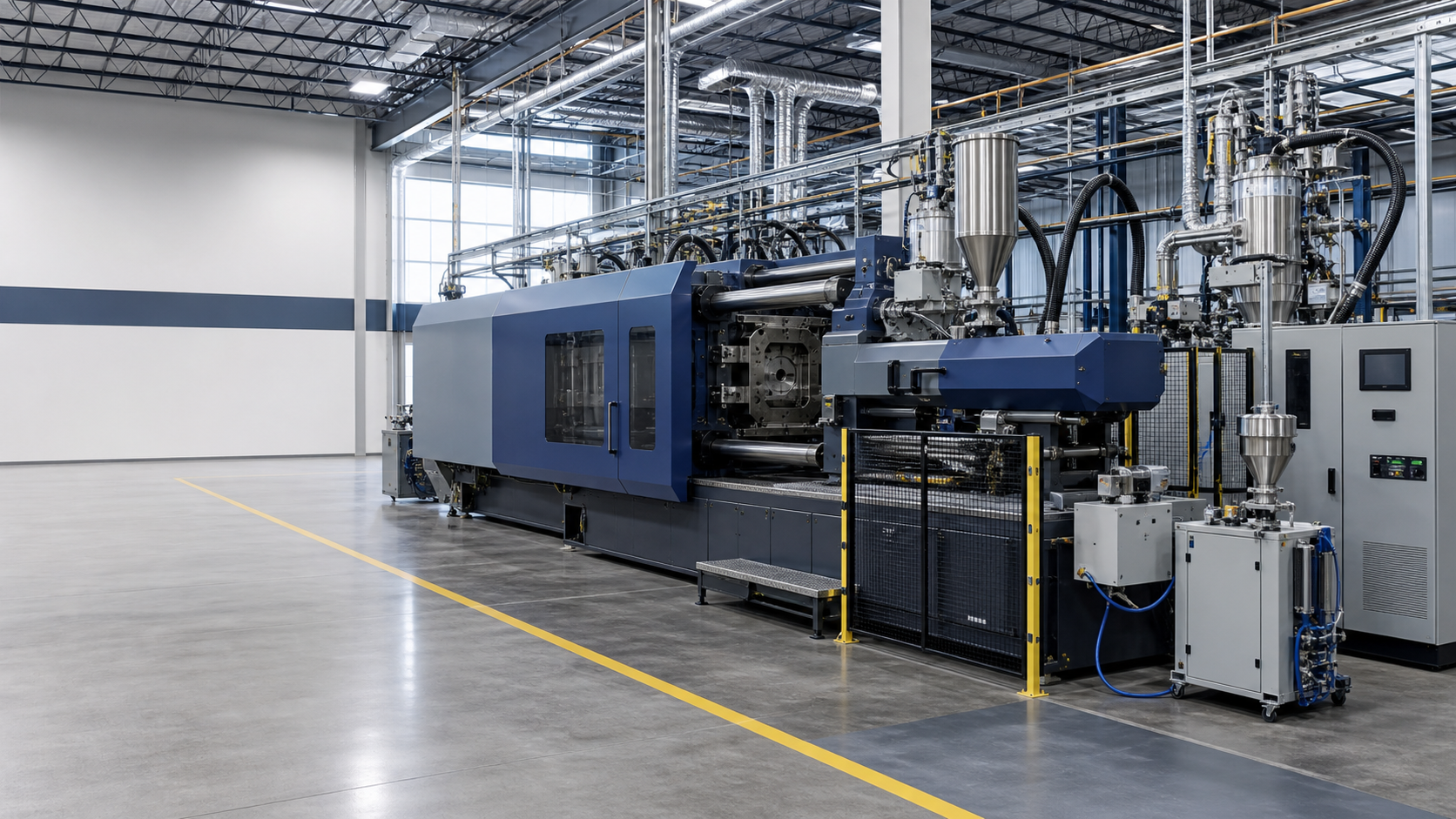
Our injection presses range from 55 to 1,500 tons. We evaluate projected area, shot size, mold layout, resin, geometry, and process conditions to select the press for your part.
Material handling
Our production systems include automated material handling, central drying, large-capacity cooling, and electronic press monitoring. We review your resin and its processing requirements when planning production.
Complex molding
Two-shot molding and overmolding can reduce separate assembly steps on suitable parts. We also offer robotics-assisted production and gas counter-pressure molding for applications that benefit from these processes.
Process confirmation
Our engineering, tooling, production planning, and quality teams review your requirements together before finalizing the process.
Design tooling as part of the manufacturing plan
Mold construction, maintenance, modifications, press fit, material behavior, cooling, ejection, and future production needs all influence the production plan. Our in-house tooling department supports this work with CNC machining centers, CNC EDM, automated grinding equipment, and mold-making machinery.
We routinely handle molds weighing up to 30,000 pounds and support them through construction, maintenance, and modifications. Prepare your part files, material, production volume, finish and tolerance requirements, and existing tool history for our tooling review.
Plan the work after molding
A molded part may need finishing, assembly, packaging, storage, or distribution before it reaches your customer. Our secondary operations include ultrasonic welding, pad printing, silk screening, hot stamping, mechanical and electrical assembly, insertion, and film application.
Include these needs in your initial project brief. We plan molding together with assembly and packaging and warehousing and distribution. Our quality team helps identify the checks and records your product needs, and we use the complete scope to prepare pricing and a production schedule.
Turn a molding question into a project brief
Contact us with a brief description of your part and production needs. We will arrange a review of your drawings, tooling, material, volume, and delivery requirements.